
Life Jackets for Toddlers on a Private Yacht: Fit and Safety
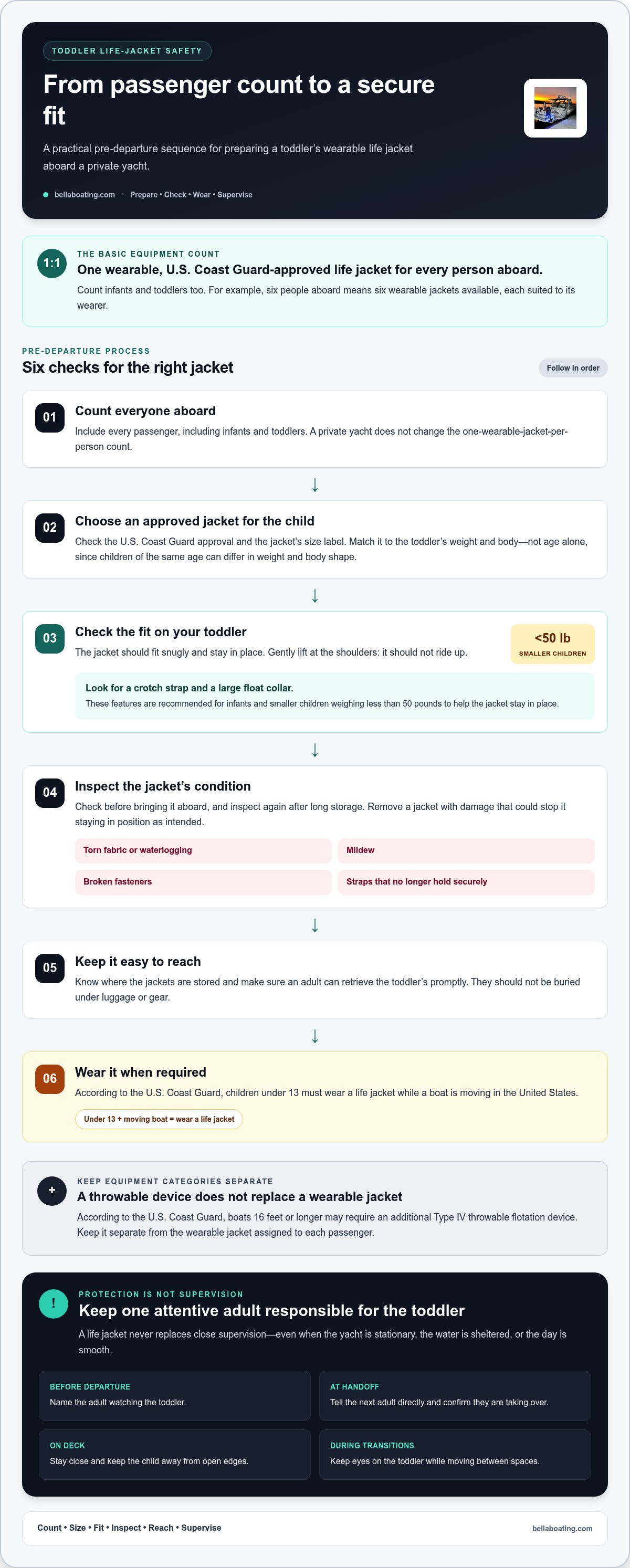
Yes, there are life jackets for toddlers on a private yacht. Each person aboard should have a properly sized, U.S. Coast Guard-approved wearable life jacket, and according to the U.S. Coast Guard, children under 13 must wear one while a boat is moving. A toddler’s jacket should fit snugly and stay in place, not ride up when gently lifted at the shoulders.
It’s natural to want a calm, comfortable outing while keeping your child safe. A life jacket is essential protection, but it never replaces close, attentive supervision, even in a sheltered cabin or on a smooth day at sea.
This guide explains how to choose a toddler life jacket, check its fit and safety features, and decide when your child should wear it aboard a private yacht. The jacket should be in good condition, easy to reach, and worn when required, so you can prepare thoughtfully for your family’s time on the water.
Table of Contents
Carrying one approved wearable life jacket per passenger
Count everyone aboard before setting out, including infants and toddlers. Boaters should carry one wearable, U.S. Coast Guard-approved life jacket for each passenger. A private yacht doesn’t change that basic count. If six people are aboard, six wearable jackets should be available, each suited to its wearer.
For a child, both age and weight matter when choosing a size. Age alone doesn’t establish a safe fit, since children of the same age can differ in weight and body shape. Check the jacket’s label and assess the fit on the child who will wear it.
Approval is another essential consideration. A wearable jacket should be U.S. Coast Guard-approved, correctly sized, easy to reach, and in good condition. “Easy to reach” means passengers can access it without digging through luggage or struggling with storage. Before departure, identify where the jackets are kept and make sure an adult can retrieve the toddler’s promptly.
Inspect each jacket before bringing it aboard. Look for torn fabric, waterlogging, mildew, broken fasteners, or straps that no longer hold securely. A damaged jacket may not stay in position as intended. If it has been stored for a long time, inspect it again before the next outing rather than assuming it is still usable because it was previously approved.
Count: Match one wearable jacket to each person aboard.
Fit: Match the child’s size to the jacket label and body.
Access: Keep jackets reachable, not buried under bags or gear.
Condition: Remove jackets with rips, waterlogging, or mildew.
Wearable jackets and throwable flotation devices serve different purposes. According to the U.S. Coast Guard, boats 16 feet or longer may require an additional Type IV throwable flotation device. That extra item does not replace the wearable jacket assigned to each passenger. Keep the two categories separate in your safety count, so the throwable device isn’t mistaken for a child’s personal life jacket.
Recheck the passenger count whenever someone joins or leaves the yacht. If another adult comes aboard, for example, an additional properly sized wearable jacket is needed. Recounting also helps confirm that the toddler has a jacket assigned to them, rather than a spare intended for someone else. Clear allocation helps keep the right equipment available for everyone.
Adult supervision
A toddler needs an attentive adult nearby throughout the outing, not just while the yacht is underway. Assign one adult to watch the child during each part of the trip. This makes responsibility clear while other passengers talk, move around, or enjoy the view. A life jacket adds protection, but it doesn’t replace adult supervision.
Choose a supervisor who can focus on the child rather than sharing the task casually among several adults. Before leaving the dock, for example, agree that one person will watch the toddler while another talks or takes photographs. If the assigned adult needs to step away, they should name a replacement directly. A clear handoff prevents gaps in attention.
On deck, keep the toddler within easy reach and watch how they move around seats, steps, and open areas. A child may suddenly turn toward a toy or follow a familiar adult without noticing the boat’s edge. Stay between the child and open water, especially when moving between the cabin and deck. Keep your attention on the child, not just their location.
Supervision matters even when the yacht is stationary. A boat can shift with its surroundings, and a toddler may wander while adults assume a quiet moment is low-risk. Keep the child close during boarding, when passengers change places, and whenever attention turns to bags, food, or equipment. If the child is resting in an enclosed area, an adult should still know where they are and remain attentive.
Before departure: Name the adult responsible for watching the toddler.
During a handoff: Tell the next adult directly, rather than assuming they noticed.
On deck: Stay close and keep the child away from open edges.
During transitions: Keep eyes on the toddler while moving between spaces.
Water activities need the same deliberate attention. If a toddler is near the water for any reason, one adult should focus on that child without distraction. Don’t rely on another passenger’s general presence as supervision. A group can create a false sense that someone is watching, while each person assumes another adult has taken responsibility. Naming one supervisor removes that uncertainty.
As conditions or activities change, reassess who is watching the child. If the supervisor starts helping another passenger, they should transfer responsibility first. Make the handoff brief and explicit: identify the child, confirm who is taking over, and remain engaged until that person acknowledges the task. This routine supports consistent attention from boarding through the end of the outing.
Crotch straps and float collars
For infants and smaller children weighing less than 50 pounds, look for a life jacket with a crotch strap and a large float collar. These features help the jacket stay in place on a small body. A toddler’s movement aboard a vessel can shift loose clothing and equipment, so secure positioning matters before the boat gets underway.
A crotch strap passes between the child’s legs and connects to the lower part of the jacket. Fasten it as the manufacturer instructs, then check that it lies flat without twisting. It should help keep the jacket from riding upward without pinching or restricting movement. If the strap is loose, the jacket may shift when the child sits, stands, or reaches.
The float collar sits behind and around the neck. On a small child’s jacket, its shape helps keep the jacket correctly positioned. Lay the collar flat before fastening the front closures, and make sure it isn’t folded under a hood or clothing. Check that the child can turn their head comfortably while the collar stays in place.
Before dressing: Check that the crotch strap and collar are present and undamaged.
After fastening: Confirm the crotch strap lies flat and connects securely.
At the shoulders: Arrange the collar as designed, without folds or trapped fabric.
Before boating: Let the child move, sit, and reach while wearing the jacket.
Check the entire jacket, not just its closures. Make sure every buckle or zipper is secured and the straps aren’t twisted. Watch the child sit down and stand again. If the jacket shifts noticeably, readjust it according to its label and repeat the check before boarding. A jacket that feels comfortable while standing may fit differently when the child sits.
Clothing can affect how the jacket fits. A bulky layer underneath may change its fit, while a hood can bunch beneath the float collar. Dress the child in the clothing planned for the outing, then check the jacket again. Aim for a snug, comfortable fit that stays correctly positioned as the child moves.
These features don’t replace supervision or an appropriately sized, approved jacket. For a child below the 50-pound threshold, treat the crotch strap and large float collar as important fit considerations. Read the jacket’s instructions, use its adjustment points as directed, and include the strap and collar in every pre-boarding fit check.
Infant life jacket fit and safety features
For an infant, start with the jacket’s weight range rather than its appearance or the child’s age alone. Fit also depends on the child’s body, so compare the jacket label with the infant’s current weight and chest measurement before boating.
Chest size provides another useful fit check. The listed infant range is 16-20 inches. Measure the child and compare that result with the jacket’s sizing information; don’t assume a jacket fits simply because it matches the child’s age. A close match across weight and chest measurements helps the jacket sit as intended without being uncomfortably tight.
Fasten the jacket and check that it feels snug but comfortable. The fabric and straps should sit securely, not hang loose, while allowing the infant to move naturally. Check the fit with the clothing planned for the outing. A thick layer can change how the jacket rests against the body, so repeat the check after dressing.
Infant jackets often have extra features intended to help keep them in place. Inspect these before each boating trip and follow the jacket’s instructions for fastening and adjustment. Look over the fabric, closures, and straps for visible damage. A jacket that cannot be secured as designed isn’t ready to wear.
Compare: Check the child’s weight and chest measurement against the jacket label.
Fasten: Secure each closure as the manufacturer directs.
Observe: Confirm the fit is snug, comfortable, and allows natural movement.
Inspect: Look for damage that could affect the jacket’s fit or fastening.
Test the fit before boating, while the infant is calm and dressed for the outing. Check that the jacket stays correctly positioned as the child moves, then adjust it according to its instructions. Repeat the check if the child’s clothing changes or the jacket is put on again. This practical test can reveal a loose or uncomfortable fit before boarding.
Check the flotation type as well as the size. A Level 70 life jacket is not designed to turn a person face up. That detail matters when choosing equipment for an infant, because a snug fit and flotation level are separate considerations. Read the label rather than treating all approved jackets as interchangeable.
Federal rules address when children must wear life jackets, while weight and fit help determine which jacket suits an infant. Keep those decisions distinct. Choose an approved jacket that matches the infant’s measurements, fit it according to its instructions, and have an adult supervise the child throughout the outing. A properly fitted jacket supports safety but doesn’t replace attentive care.
Whether toddlers need to wear life jackets on boats
For toddlers, wearing a life jacket is a legal requirement underway and a practical safety measure aboard a yacht. The exact rule depends on where the boat operates, but federal law provides a clear starting point.
Toddler Life Jacket Wear
The U.S. Coast Guard says federal law requires children under 13 years old to wear a life jacket on a moving boat in the United States. According to the U.S. Coast Guard, federal law requires children under 13 years old to wear one on a moving boat. A yacht’s private setting doesn’t remove this requirement, so have the child wear a properly fitted jacket whenever the vessel is underway.
State rules and exceptions can vary, so the route matters when determining wearing requirements. A child moving between deck and cabin still needs close attention. Make putting on the jacket part of preparing the toddler for the outing, rather than waiting until the yacht is already moving.
Inflatable Jacket Suitability
No. Inflatable life jackets aren’t meant for children under 16, so they aren’t suitable for toddlers. Choose a child-sized, U.S. Coast Guard-approved wearable jacket instead, with sizing that matches the toddler’s weight and body. An adult inflatable jacket isn’t an appropriate substitute simply because it can be fastened around a small child.
Read the label and follow its age and weight guidance. A toddler needs equipment designed for their size and fit, not just a flotation device that appears wearable. Test the jacket on the child before boarding, and make sure its closures and straps hold it securely in place.
Yacht Risks and Safety Precautions
A toddler can lose balance while moving around a yacht, and an unexpected shift can make open water a serious hazard. Boarding, moving between cabin and deck, or being near the water can also create moments when a child slips beyond an adult’s reach. A life jacket provides flotation, but it doesn’t prevent falls or replace supervision.
Before departure, assign an adult to watch the toddler and make the handoff explicit if that person steps away. Keep the child close on deck, away from open edges, and in a properly fitted jacket while underway. Keep jackets accessible and maintain supervision when the yacht is stationary, too. Calm conditions don’t remove the need to watch the child.
Planning a family outing? Explore a Coastal Tour and prepare your toddler’s safety essentials before setting out.
Bella Boating: Sunset Cruise
Bella Boating’s Sunset Cruise offers a private yacht setting for enjoying the coast as the day draws to a close. After choosing an appropriately fitted life jacket and planning adult supervision, you can focus on a relaxed family outing. The same preparation applies to a Coastal Tour, Malibu Excursion, or Catalina Island Trip: bring a properly sized jacket for your child and maintain safety routines throughout the trip.
Bella Boating’s private yacht experiences offer families a way to enjoy the Marina del Rey coastline together. Keep your toddler’s needs central to your plans, from wearing a life jacket while underway to staying within an adult’s reach. To plan a family outing, contact Bella Boating or visit bellaboating.com.
Plan Your Family’s Next Day on the Water
Knowing whether there are life jackets for toddlers on a private yacht helps you plan with care, but your family’s next step is turning that preparation into a relaxed outing. Think about the pace and scenery your family would enjoy, then make your toddler’s comfort and supervision part of the plan from the start.
Bella Boating offers a Sunset Cruise, Coastal Tour, and Malibu Excursion, each giving families a different way to enjoy the Marina del Rey coast. Choose the experience that suits the kind of day you have in mind, while keeping your child’s safety needs central to the plan.
For a family outing shaped around your interests, contact Bella Boating. With thoughtful preparation, you can look forward to sharing the water and coastline together.
Frequently Asked Questions
How Can I Learn More About Life Jackets and Boat Safety?
Review U.S. Coast Guard boating safety guidance and the rules for the waters on your route. For a practical family plan, write down who will supervise your toddler, where the child’s jacket is stored, and how to manage transitions between the cabin and deck. Discuss responsibilities with the adults joining the outing before boarding, so everyone understands the plan.
Are toddler life jackets available for private yacht use?
Yes, toddlers can wear life jackets on a private yacht. Choose a wearable jacket approved by the U.S. Coast Guard and designed for the child’s weight and body size. A private vessel doesn’t change the need for a proper fit. Before leaving, make sure the jacket is in usable condition and that the adult responsible for the child knows where it is kept.
What type of life jacket is safest for toddlers on a yacht?
There isn’t one type that suits every toddler; size, fit, and the child’s swimming ability matter. For children who aren’t swimmers, a Type II child vest is recommended because it has greater buoyancy than a Type III PFD. Inflatable life jackets aren’t meant for children under 16, so don’t choose one for a toddler. Follow the jacket’s age and weight label.
How do I choose the correct life jacket size for a toddler by weight?
Use the child’s current weight and the jacket’s sizing label rather than choosing by age alone. Sizing charts can overlap, so compare the child’s measurements with the specific jacket’s guidance and check the fit on the child before the outing.
Are life jackets required for toddlers on private boats in the United States?
Yes. According to the U.S. Coast Guard, federal law requires children under 13 years old to wear a life jacket on a moving boat in the United States. A private boat is still a boat for this requirement. The rule described for federal law doesn’t apply when the boat isn’t underway or when a child is below deck or in an enclosed cabin.
What are U.S. Coast Guard rules for children wearing life jackets on yachts?
The federal rule requires children under 13 years old to wear life jackets on moving boats in the United States, according to the U.S. Coast Guard. The stated exceptions include a boat that isn’t underway and a child below deck or inside an enclosed cabin. State requirements may differ, so the route matters. Use an approved, properly sized wearable jacket for the child.
Do private yachts have to provide toddler life jackets for passengers?
Boaters should carry one wearable, U.S. Coast Guard-approved life jacket for each person aboard, including each toddler. The jacket should fit the child, rather than simply being an adult spare. Before boarding, assign a jacket to the toddler and note where it is stored. This prevents confusion if passengers change places or someone needs to locate the child’s equipment quickly.
How should a toddler life jacket fit and be secured?
It should feel snug and comfortable, with closures fastened as the manufacturer directs. For an infant or smaller child weighing less than 50 pounds, look for a crotch strap and large float collar. Check that straps lie flat and the collar isn’t folded beneath clothing. Have the child sit, stand, and move in the jacket, then adjust it according to its instructions.

Comments